


Architecture as memory
A dialogue with Flavia Marcello
Flavia Marcello’s background in architecture laid the foundation for a compelling examination of how Rome’s built environment reflects its political past. In After the Fall: The Legacy of Fascism in Rome’s Architectural and Urban History, she explores architecture as a medium for collective memory, revealing an unfolding narrative of Italy’s reckoning with its fascist past.
Your degree in architecture marked the beginning of an unexpected journey. How did your reflection on the architectural traces of Italian Fascism emerge?
After earning my degree in architecture, I became convinced that I didn’t want to be an architect. So, I decided to move to Rome with my Italian fiancé, and there started teaching English at Esposizione Universale Roma (EUR). Every time I went to teach, I observed these monumental buildings that bore an evident Fascist imprint, and asked myself: “What does all this mean?” I wondered how a democratic regime, a republic, and the strength of the left could coexist with these Fascist symbols.
Meanwhile, I discovered that I really enjoyed teaching, yet my true passion remained architecture, ever since I was 8 years old. I decided to become a university professor to teach architecture, and persuaded my husband to return to Australia so I could pursue a PhD, focusing precisely on the architectural and urban legacy of fascism in contemporary Rome.
As I began my thesis, my supervisor said, “If you want to study the effect of Fascism in the postwar period, you must first study Fascism itself.” I took on the challenge, did the research, and submitted this work. When I told her I was ready to start writing my thesis, she replied, “No, this is already a thesis.” So, I finalised it, and for the next twenty years I became an expert in Fascist architecture.
The idea that first came to me during those years of commuting to teach never left me. One day, at a conference, I met an editor from Bloomsbury. While chatting, I mentioned that I had always wanted to write a book about that idea. The editor was enthusiastic and said, “Send me a proposal.” Within a month, I had a contract to write the book.
Is there a place in Rome that inspired this vocation more than any other?
I have to go back to a beautiful childhood story. My grandfather Franco, who was passionate about art and architecture, would take me on walks around Rome. He brought me to Piazza Navona and told me the story of Bernini’s Fontana dei Quattra Fiumi and Borromini’s Sant’Agnese in Agone. He showed me the figure in the fountain, raising its arm as if afraid that Borromini’s building would collapse on top of it, because the two architects didn’t get along. That story stuck with me, and I’ve always wanted to learn more about the history of Rome, its architecture, and its architects. I believe my passion was ignited during those walks with my grandfather.
You recognized your calling in the places you visited—places that spoke to you and told you who you were. Is there an emblematic example that, in your opinion, best represents Fascism’s historical legacy, the integration of past and present?
I would say the Palazzo della Civiltà Italiana. It’s the one everyone chooses, but I believe it’s the perfect building to tell this story. Not only because of its evolving use over time, but also because it’s an interpretation of the Colosseum.
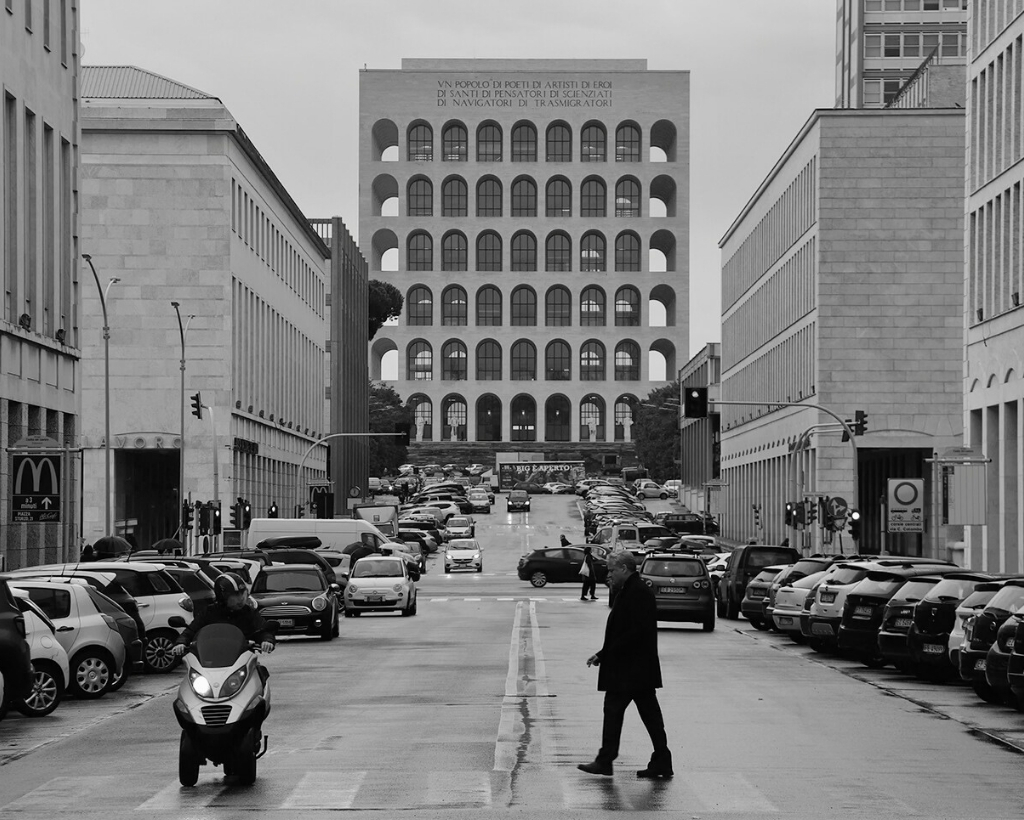
One of the most important concepts for the Fascist regime was Romanità—the idea of interpreting ancient Roman ideals within the context of the contemporary regime. By taking the Colosseum, an icon of Roman architecture, and making it square says something about Romanità. Structurally, it’s a cube cut by arches—arches that are actually “ghosts.” A true arch is made of bricks, but they built a reinforced concrete structure clad in marble. This speaks to the very essence of fascism: something modern covered in the marble of antiquity. Fascist ideology itself was a “ghost,” much like these arches.
I imagine there was also a desire to convey the grandeur of the Roman Empire as a foundational legacy of the new Fascist regime?
Exactly. Moreover, the fact that a quote from Mussolini is still visible on the parapet means that Italy has not fully come to terms with its Fascist past. When reading that inscription, one might say, “Yes, it’s true, Italy is a nation of poets, scientists, innovators.” What Mussolini stated isn’t necessarily false, but when taken out of context, it takes on a different meaning.
All the monuments and architectural works I discuss in the book no longer exist within the Fascist-era context, so they aren’t perceived in the same way. The language is gone, and the cultural and historical references needed to understand their symbolic value are no longer there.
What key factors influenced the transformation and integration of architecture after the Fascist period?
More than anything else, the 1931 piano regolatore (urban development plan). This plan remained in effect until 1967. The Fascist layout of the city had been superimposed onto the existing city, and that’s not something that can be undone overnight. Under a democratic regime, these processes take much longer.
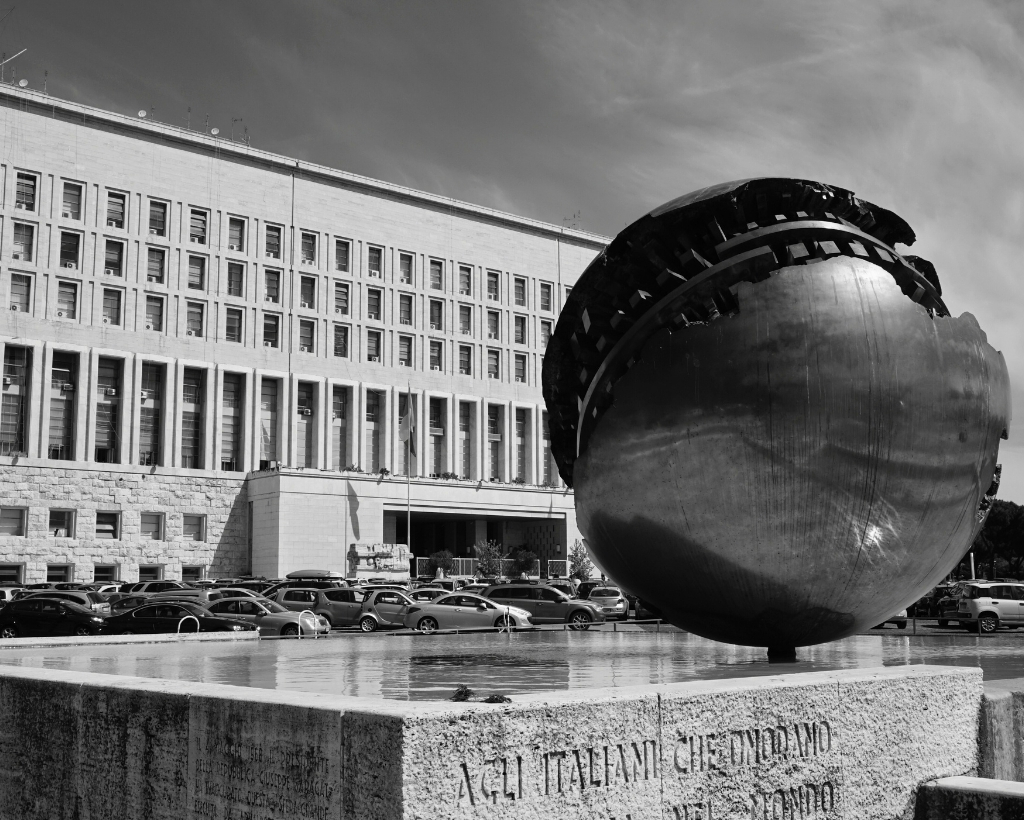
Then there’s the influence of the Società Generale Immobiliare of the Vatican—an aspect that should never be overlooked. They owned vast tracts of land and significantly influenced major decisions. Take the 1960 Olympics, for example: part of the events took place at EUR, while others at the Foro Italico, reusing two of the most iconic sites from the Fascist era. This was no coincidence. The Olympic Way increased the value of land in Boccea and along the Aurelia—areas owned by the Società Generale Immobiliare. It was in their interest to continue following the 1931 piano regolatore.
Rather than focusing solely on the technical aspects of history and architecture, your book uses accessible language to reach a broad readership. What message do you hope readers will take away?
Great question! The central message is: “It’s complicated.” There’s no clear-cut answer on what to do with this architectural legacy. It depends largely on who is looking at the buildings, how they interpret them, and how they use them.
From a practical standpoint, post-war Italy had to rebuild and needed these buildings. I believe that reclaiming a structure that speaks of fascism and making it tell a different story—the story of a democratic regime—is crucial. We don’t have to demolish these buildings, nor should we leave them abandoned. Instead, we must repurpose them, take ownership of them, and present them to the contemporary public in a new light.

