


Wine, notes and Unesco hills
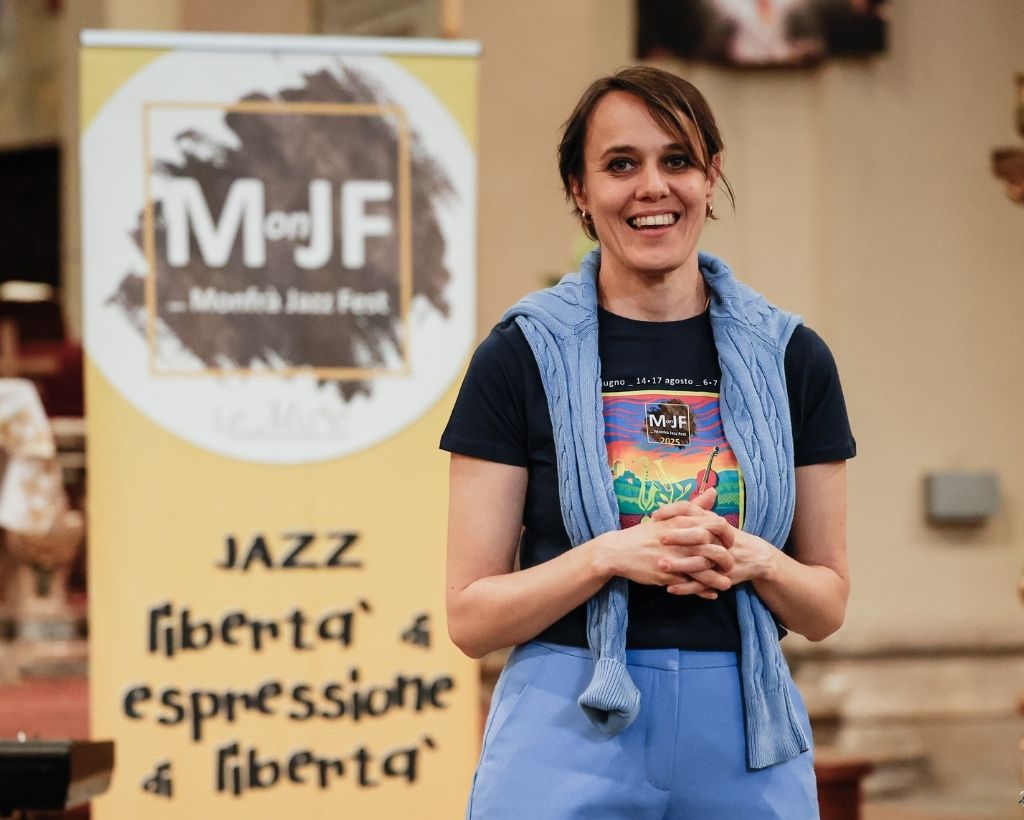
Ima Ganora on the Monfra Jazz Fest
Until September 2026, a corner of Northern Italy between Turin and Milan is the stage for the Monfrà Jazz Fest, offering a rich program set amid landscapes steeped in medieval history, centuries-old winemaking traditions, and natural beauty.
In 2014, Monferrato was designated a UNESCO World Heritage Site in recognition of its centuries-old tradition as one of five distinct wine-growing and winemaking areas of the Piedmont region. From 2018, it also been home to the Monfrà Jazz Fest.
This year, the festival’s artistic director, Ima Ganora, invites audiences into a truly immersive sensory experience—one that reflects the unique identity of the region, where the essence of Italian lifestyle unfolds between a glass of Monferrato red and the rhythms of exceptional music.
Since its inception, the Monfrà Jazz Fest has grown into an event of international significance. Yet its origins are disarmingly simple.
“What happens,” Ganora reflects, “when jazz is brought into a landscape that already has its own intrinsic musicality?”
The Monferrato is not just a place—it is a soundscape. The wind moving through the vineyards, the stillness of its villages at dusk, and even the shifting light across the rolling hills contribute to a natural rhythm. Jazz, with its delicate balance between structure and improvisation, seemed the perfect language through which to engage in dialogue with such a layered environment.

Now in its ninth edition, the festival positions Monferrato at a crossroads of global sound. This year’s theme—Lands of Jazz: Syncopated Continents and Off-Route Islands—reflects a broader vision of cultural regeneration.
“Jazz has no fixed home—and that is its strength,” Ganora explains.
The “syncopated continents” represent the traditions jazz has touched and continues to nourish—from American blues and African musical traditions to Spanish flamenco and Brazilian samba rhythms. The “off-route islands” evoke unexplored territories: the unexpected places where jazz arrives not through convention, but by chance.
Monferrato is one such place. Not Montreux, not New Orleans, but a rural landscape in Piedmont, rich with vineyards, villages, and centuries of history. By hosting artists from more than twenty countries and staging world premieres in venues such as the Paraboloid of Casale Monferrato and historic churches, the festival demonstrates that cultural innovation often emerges away from the spotlight—on the margins, in creative peripheries, in places not yet fully mapped.
While the festival currently collaborates with institutions in Switzerland and Catalonia and is part of the national I-Jazz network (Associazione Nazionale Festival Jazz Italiani), Ganora acknowledges that the time may be right to look further.

“Australia has a vibrant and original jazz scene,” she notes. “Its relationship with contemporary jazz and Pacific influences could bring something truly unexpected to a festival like ours.”
She sees this dialogue as a first step—an open invitation to explore new cultural bridges through music.
What defines Monfrà Jazz Fest is not only its programming, but its unconventional stages
“Everything changes when you perform in a 17th-century church or a castle courtyard,” Ganora says.
In enclosed historical spaces, reverberation transforms sound—notes linger and overlap, creating textures no modern concert hall can replicate. Musicians respond instinctively, slowing down, allowing space, entering into dialogue with the architecture itself.
Outdoors, the experience shifts entirely. Sound disperses into open air, requiring artists to project differently and adapt their presence to the vastness of the landscape.

The festival’s identity is shaped not only by sound, but by the wider sensory world of Monferrato itself. If the festival were a wine, what would it be?
Ganora doesn’t hesitate: Grignolino.
“Not just out of habit,” she smiles, “but because Grignolino is truly Monferrato jazz.”
Noble yet rebellious, refined yet untamed, this historic wine—first documented in 1249—has preserved its character across centuries. With its vibrant tannins, notes of red fruit and geranium, and playful unpredictability, Grignolino never offers the same experience twice.
Each hill shapes its personality, each vintage reinterprets it, each winemaker leaves a distinct imprint. It is, in essence, a variation on a theme—much like jazz itself.
Served slightly chilled on a summer evening, light in the glass yet lingering in the mind, it becomes the perfect companion to an open-air concert—enhancing, never overpowering.

