


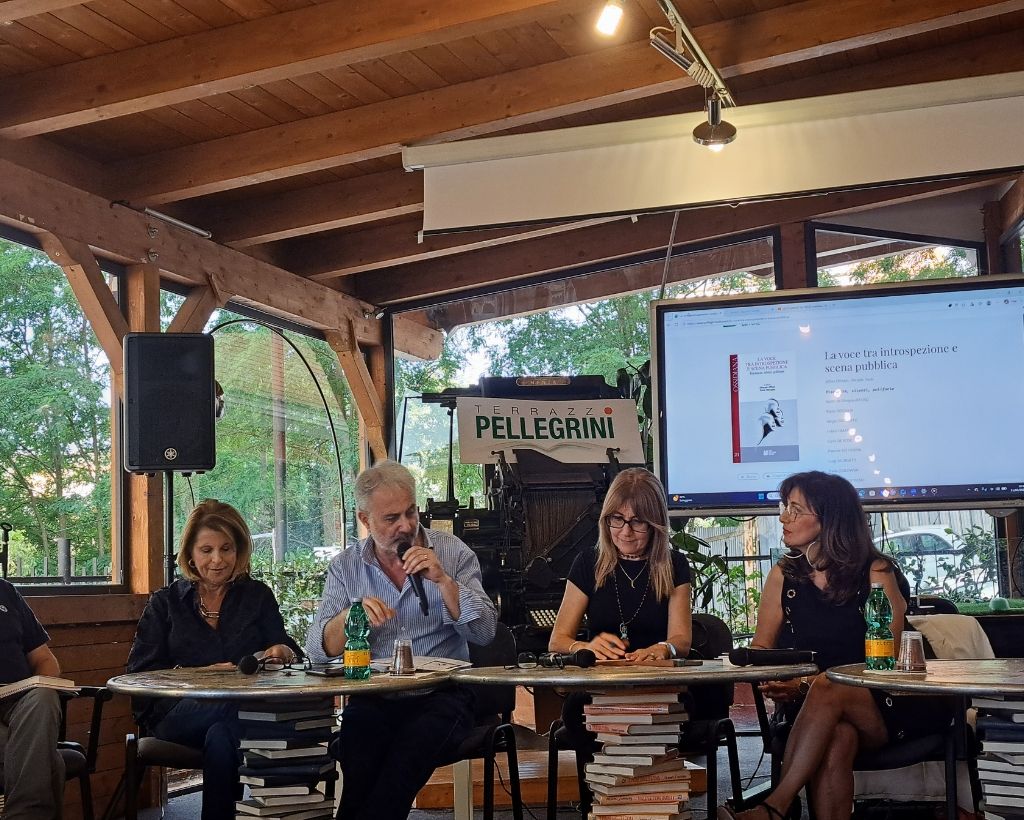
From voice to voice
BETWEEN PERSONAL IDENTITY AND PUBLIC SPACE
La voce tra introspezione e scena pubblica explores the voice as a powerful expression of identity, emotion, and human connection, examining its psychological, social, political, and cultural dimensions in an increasingly digital world.
We live in an age of notifications, voice notes, and emojis used to communicate emotions. Today, we increasingly find ourselves speaking with artificial intelligence as though it were a real presence. And yet, amid this constant flow of communication, listening and intimacy seem to be diminishing. The human voice risks losing its place—and its time—within communication itself.
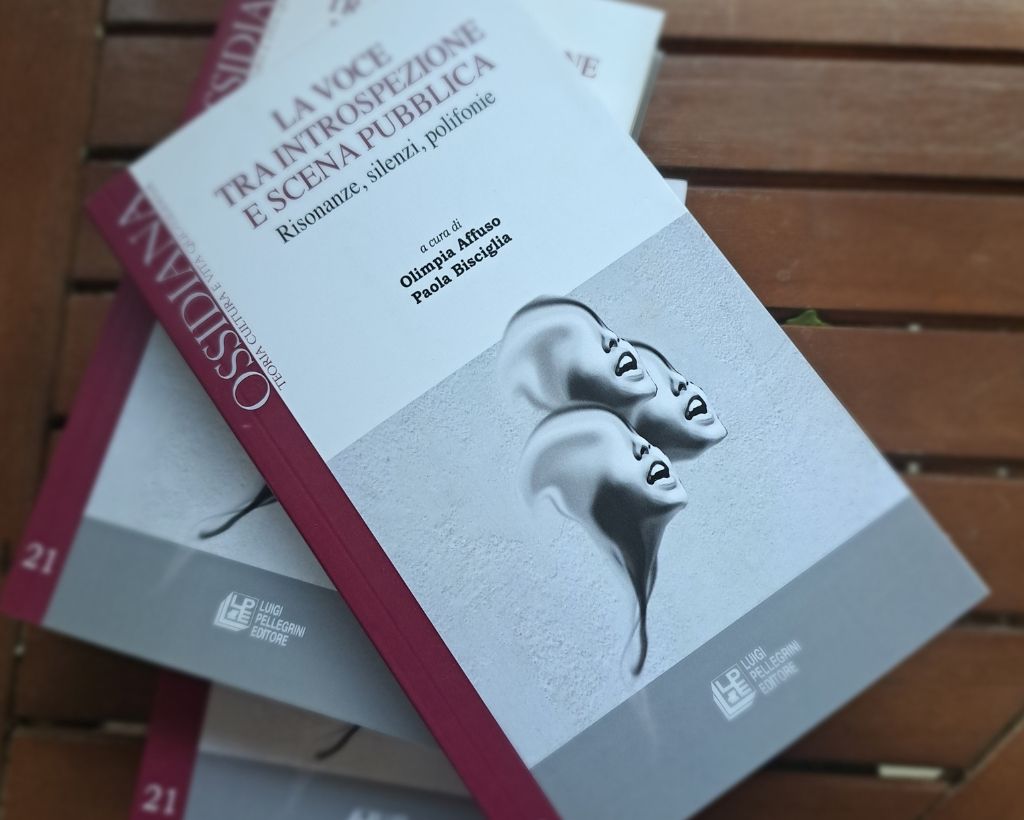
It is from this tension between hyper-communication and the loss of genuine listening that the need emerges to rethink the meaning of the voice today. More than a simple instrument of expression, the voice reveals identity, creates relationships, and shapes forms of political and social engagement. These reflections are at the centre of La voce tra introspezione e scena pubblica. Risonanze, silenzi, polifonie (“The Voice Between Introspection and Public Life: Resonances, Silences, Polyphonies”), which we edited in the Ossidiana series, and published by Luigi Pellegrini Editore.
Everyday communication now moves through an uninterrupted flow of messages, calls, memes, and video clips. We speak while doing something else, reply while preparing lunch, and listen to voice messages at double speed to save time. Digital technologies allow us to remain constantly connected while simultaneously being elsewhere. It appears that our capacity for listening is rapidly fading.
The voice travels together with words. It speaks about us and for us. It reveals our presence, our intentions, and our emotional states. At times, it even betrays the deepest parts of the self. In its movement from mouth to ear, the voice creates social spaces, shapes relationships, and extends beyond physical proximity through the technologies that amplify and transmit it.
From a sociological perspective, as German philosopher and sociologist Georg Simmel had already intuited, the voice is not merely an expressive medium. It is a symbolic form through which we encounter others and negotiate our relationship with them, intertwining immediate perception with the expression of identity.
At the same time, the voice is a privileged instrument for understanding the person. It forms an integral part of non- or para-verbal communication and, above all, an expression of being.
In psychotherapeutic practice, one listens not only to what is being said, but to how it is said: the rhythm of speech, the pauses, silences, hesitations, and changes in tone. Vocal expression preserves traces of emotions, conflicts, desires, and vulnerabilities that often emerge before they can be fully articulated in words. Listening, in this sense, means welcoming a presence in all its complexity and recognizing the sonic dimension as an essential component of relationship and care.
During clinical interviews, it is frequently observed that individuals do not possess only one voice, but many. Different tonalities emerge from different dimensions of the self: the child self, the adult self, the parental self. The voice may become high-pitched and plaintive, joyful and resonant, controlled and measured, severe and authoritarian, or warm and reassuring. Through these variations, people reproduce emotional patterns and relational modes internalized through their histories and relationships with caregivers.
The voice is not only an expression of the self, but also a public space: a form of democratic participation and political experience. It inhabits cinema, theatre, literature, and comics, becoming both artistic material and social presence. Even silent cinema paradoxically evokes it, while literature and comics attempt to render perceptible what cannot literally be heard. In this way, the voice becomes a guardian of memory, tradition, and creative impulse.
In the political sphere, the voice does not simply transmit messages through speeches. It becomes a physical and emotional experience capable of uniting people and moving them toward collective action.
The contributors bring together a notably broad range of fields, giving the volume its distinctly polyphonic character. Sociology provides the strongest thread, alongside communication and media studies, political science, philosophy of language, psychology and psychotherapy, cinema and visual culture, theatre and performance, law, and biographical approaches. Several contributors work across disciplinary boundaries, linking academic research with clinical practice and artistic forms of expression. This breadth allows the voice to be considered simultaneously as an intimate trace of self, a social and political resource, a medium of cultural representation, and a site where technology, identity, power, emotion, and memory intersect.
From this awareness emerged La voce tra introspezione e scena pubblica. The volume brings together theoretical and methodological reflections, as well as clinical cases and biographical narratives. It offers a choral encounter of disciplinary perspectives—from sociology to the philosophy of language, from clinical psychology to political theory—all reflecting on the voice as a place where identity, power, emotion, and representation intersect.
At a time when digital technologies and AI-generated voices increasingly call into question the uniqueness of human expression, this book restores the voice to the centre as presence, relationship, and the responsibility of truly being there.

