


Rome Reimagined
Walking through the eternal city
The Melbourne Museum’s ROME: Empire, Power, People exhibition transforms archaeology into lived experience, guiding visitors through the ambition, luxury, spirituality, and everyday life of the Roman Empire in one of Australia’s most immersive cultural exhibitions.
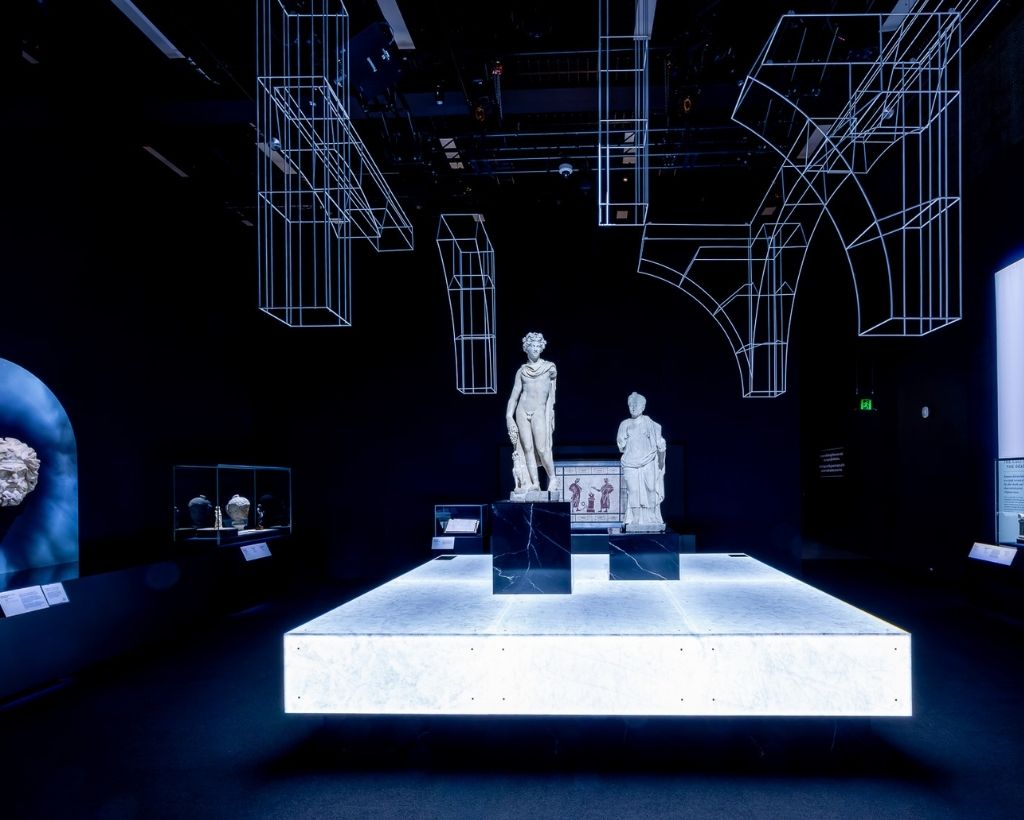
The ROME: Empire, Power, People exhibition at Melbourne Museum avoids treating antiquity as something distant and sealed behind glass. Instead, it builds its portrait of Rome through movement, atmosphere, and ordinary human detail. Visitors encounter emperors and conquest, but also children’s toys, bathhouses, theatre masks, cooking vessels, and the routines of daily life.
During a long conversation while walking through the exhibition with Nick Crotty, Collections Manager at Museums Victoria Research Institute, one idea surfaced repeatedly: the aim was not simply to display Roman objects, but to create the feeling of moving through the city itself.
That approach shapes the exhibition from the beginning. Inspired by the Italian idea of la passeggiata (a leisurely walk through streets and piazzas), the exhibition unfolds in a sequence of spaces rather than a strict chronological march. Visitors move between politics, religion, entertainment, domestic life, and death almost as if they are wandering through ancient Rome.
The opening section begins with Rome’s mythical origins. An altar showing Romulus and Remus beneath the she-wolf stands at the entrance to the exhibition, linking myth and political identity in a single image.
From there, the exhibition turns to the collapse of the Roman Republic and the rise of imperial rule to one of the most dramatic turning point in Roman history—the assassination of Julius Caesar. Portraits, coins, and sculptures lead visitors into the age of Augustus, whose carefully constructed image became one of the defining visual symbols of Roman power.
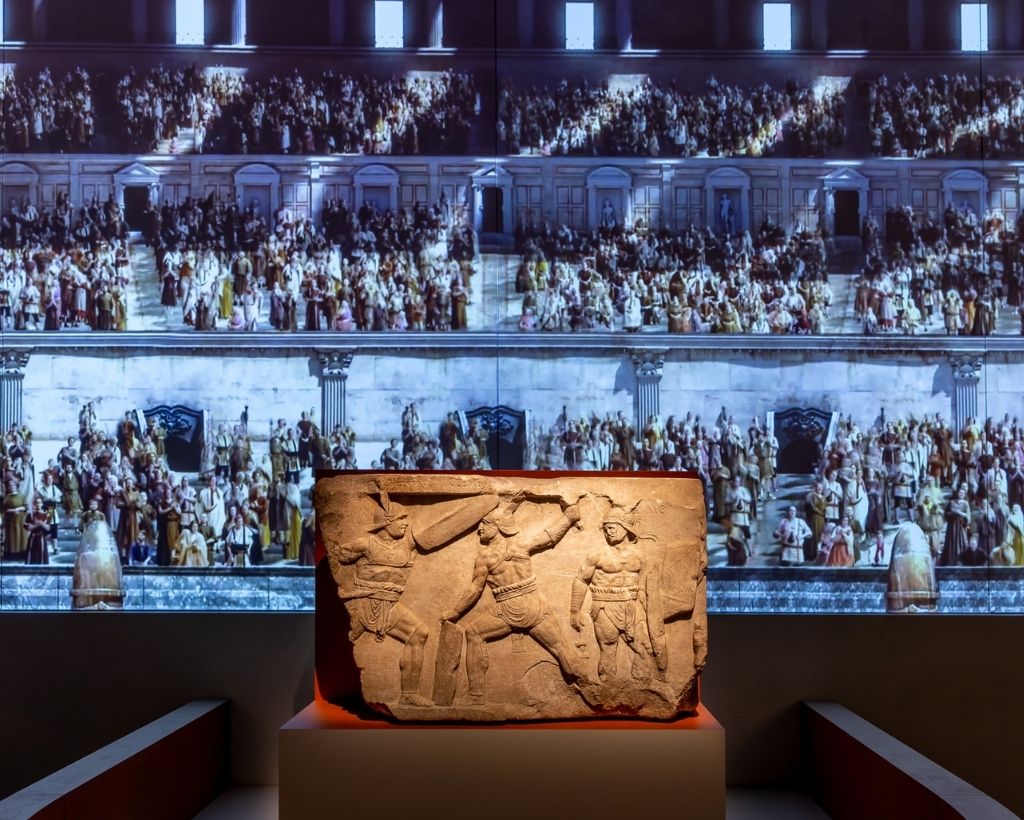
The exhibition is strongest when it narrows its focus from emperors and monuments to smaller details of everyday life. Children, merchants, actors, cooks, bathhouse visitors, and gladiators appear throughout the galleries alongside senators and rulers.
One section, Vita, concentrates on domestic life. Toys, household objects, theatrical artefacts, and personal belongings reduce the distance between the ancient world and the present one. A doll carved from animal bone sits beside a small ceramic pig that may also have functioned as a baby bottle. Nearby, a terracotta tile preserves the footprint of a Roman child from 123 CE.
The effect comes less from spectacle than recognition. These objects survive not because they were monumental, but because they were handled, worn down, misplaced, or discarded by ordinary people.
The exhibition also pushes against familiar modern assumptions about Rome. A dark grey marble sculpture depicting a person from the African region was included following consultation with historians and local African community representatives, challenging the persistent idea that Roman society — and Roman art — was culturally uniform.
Colour is another recurring theme. Modern audiences often imagine Roman sculpture as pure white marble, but traces of pigment survive on several works in the exhibition. One sculpture of Venus still carries reddish tones in the hair and painted decorative details. The ancient city suggested here is crowded, colourful, and heavily layered rather than austere and monochrome.
One of the exhibition’s most memorable spaces reconstructs the atmosphere of the Roman bathhouse. Alongside architectural elements and objects connected to bathing culture, the curators worked with Melbourne company Salus to produce a scent based on oregano and basil. The addition is subtle, but effective. It reminds visitors that ancient life was experienced through smell and sound as much as through monuments and images.
Elsewhere, the exhibition moves through theatres filled with masks and frescoes, military displays shaped by conquest and imperial propaganda, and finally into the arena itself.
The gladiator section avoids turning violence into spectacle. One figure, Clemens, emerges through fragments of surviving history. Thought to have been enslaved, he survived five battles before eventually receiving a pardon. Another gladiator earned mercy in the arena but later died from his wounds. Their stories sit uneasily beside the grandeur of Roman entertainment culture.
The largest visual gesture in the exhibition appears in the gallery devoted to Roman luxury and dining culture. At its centre stands a vast cornucopia installation overflowing with grapes, bread, olives, birds, and game associated with elite banquets. The surrounding walls draw on frescoes from the villa of Livia, reproduced across large fabric surfaces that blur reconstruction and theatrical staging.
Throughout the exhibition, the logistical scale of the project remains visible. Many works travelled from Italy through complex international loan arrangements. Some objects were considered too fragile to leave Europe, while others required rerouting because of instability affecting transport corridors through the Middle East.
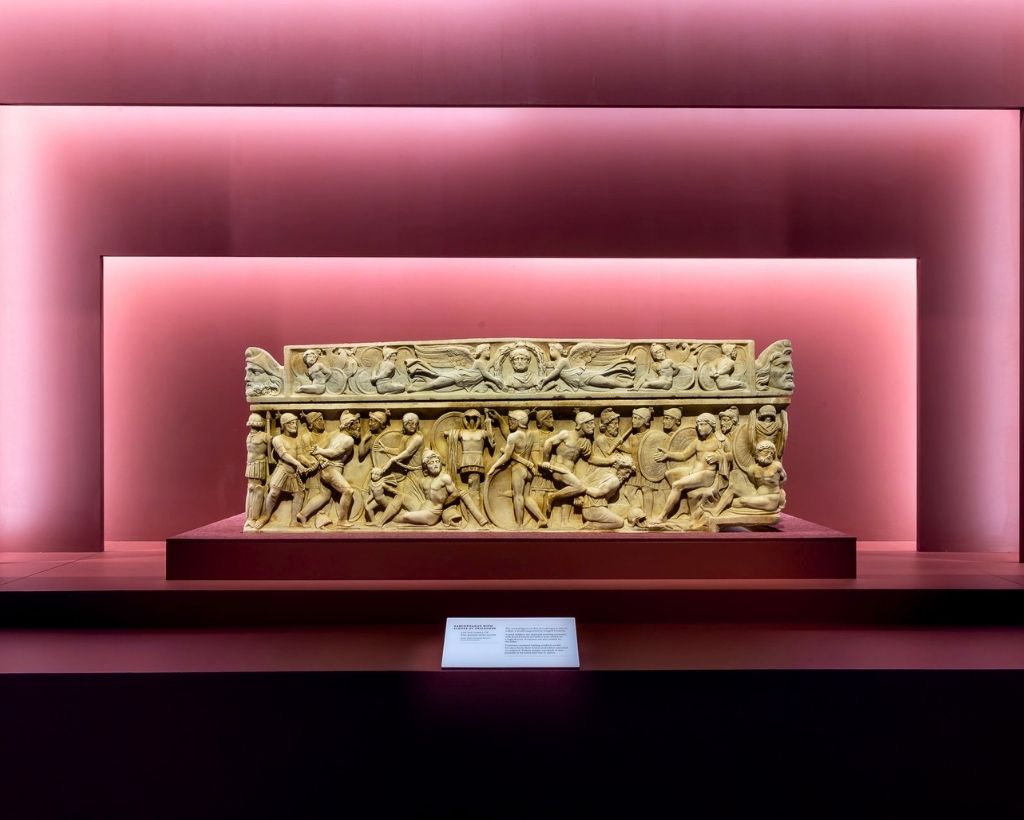
The exhibition is also among the largest—and heaviest—the Melbourne Museum has hosted in recent years, largely because of the marble sculptures and sarcophagi included in the show.
Yet the scale of the exhibition matters less than its attention to physical detail and the emotional associations those details create as visitors move through spaces shaped by ambition, mortality, spectacle, family, spirituality, and legacy. Its strongest moments help explain why Rome continues to exert such a powerful hold on the modern imagination.
The final sections of the exhibition turn toward the question of Rome’s legacy—the idea that Rome never truly disappeared. Ancient temples became churches. Imperial portraits were restored and copied during the Renaissance. The names of Julius Caesar and Augustus still survive in the modern calendar.
By the end of the exhibition, Rome feels less like a vanished civilisation than a society whose habits, symbols, and political ideas continue to echo through the modern world.

