


Bruno Leti: Memory, migration and the infinite page
An artist transforming history, philosophy and objects into visual poetry
Painter, printmaker and pioneer of the , Bruno Leti reflects on his career as an artist, post-war migration, art education, ageing, and why creative expression remains youth’s most enduring form.
For Bruno Leti, art did not begin in a studio—it began in memory. He conceptualises his art as a lifelong conversation: with place, with philosophy, and with time.
Born in Italy during the turbulent years surrounding World War II, Leti’s earliest impressions were shaped by rural landscapes, family stories marked by hardship, and a child’s curiosity about nature and the cosmos. Those formative years instilled not only visual sensitivity but habit of inquiry.
“I was always looking beyond what was visible,” he reflects. “Nature was never just landscape—it was mystery.”
When he migrated to Australia with his family as part of the great post-war Italian diaspora, art became both anchor and compass. Immigration was not simply geographical relocation; it was a reshaping of identity. The move from Italy to country Victoria, and later to Melbourne, introduced to new cultural frameworks, educational systems, and artistic possibilities.
His studies in fine arts and teacher training led to a career in art education before he transitioned to full-time practice as an artist. Yet even as a teacher, Leti’s work continued to evolve—questioning, absorbing, practicing, and expanding.
A decisive chapter in his development came through scholarships and residencies in Europe. Time at the Brera Academy in Milan reconnected him with Italy’s intellectual and artistic traditions, while extended periods in Rome and New York broadened his perspective on contemporary art discourse.

Encounters with thinkers such as Umberto Eco reinforced Leti’s belief that art and philosophy are inseparable. Semiotics, language, symbolism were not abstract academic concerns but living tools within his visual vocabulary.
International ateliers fostered cross-cultural dialogue, shaping an artistic language that is neither exclusively Italian nor Australian, but consciously transnational. “If you learn to look beyond borders,” Leti notes, “you discover that creativity is universal. Culture gives it accent, not limitation.”
Among his most distinctive contributions is his commitment to the libro d’artista—the artist’s book—as an autonomous artwork. For him, the book is not a container of images but a site where literature and visual art collaborate as equals. Projects inspired by figures such as Giorgio Morandi explore intimacy, repetition and the silent poetry of objects. Oggetti is a work that pays homage to Morandi’s contemplative still lifes, weaving narrative and visual meditation around collected forms and their histories. Poetic Experiments is another project that continues this dialogue between text and image—an exploration of the materiality of language.
Melbourne’s cultural ecosystem has played a significant role in supporting these initiatives, including partnerships and presentations connected with the booksellers Readings, whose engagement with independent publishing has helped sustain artist-book culture in the city.

Leti speaks openly about the evolution of migrant identity. The early decades of Italian-Australian life were defined by tight-knit ethnic networks, preservation of language and tradition, and a degree of cultural insularity. Over time, travel and intellectual exchange reshaped his understanding of community. “Community cannot remain nostalgic,” he reflects. “It must contribute meaningfully to the broader cultural fabric.”
In his view, Melbourne, represents a mature multiculturalism—not superficial diversity, but substantive participation across disciplines. Unlike cities where multicultural identity can remain segmented, Melbourne’s artistic scene allows for integration without erasure. Technology, urban transformation and global mobility have further dissolved rigid boundaries. Leti describes his own journey as a movement from parochial attitudes toward a more empathetic, global consciousness.
Inevitably, the conversation turns to time. Ageing, memory and even the spectre of dementia are not abstract concerns but lived realities. Yet Leti resists narratives of decline. He sees creative engagement as a form of resistance against stagnation. “Art keeps you alert; it keeps you questioning,” he says.
Music, philosophy, reading, travel are not hobbies but disciplines of youthfulness. Independence, both intellectual and physical, remains a priority. The studio is not retreat; it is engagement with life.
Both artist and interviewer agree that material success alone cannot sustain meaning. The pursuit of wealth can often erode the very values that nourish creativity. Experience, relationships and artistic inquiry offer deeper continuity.
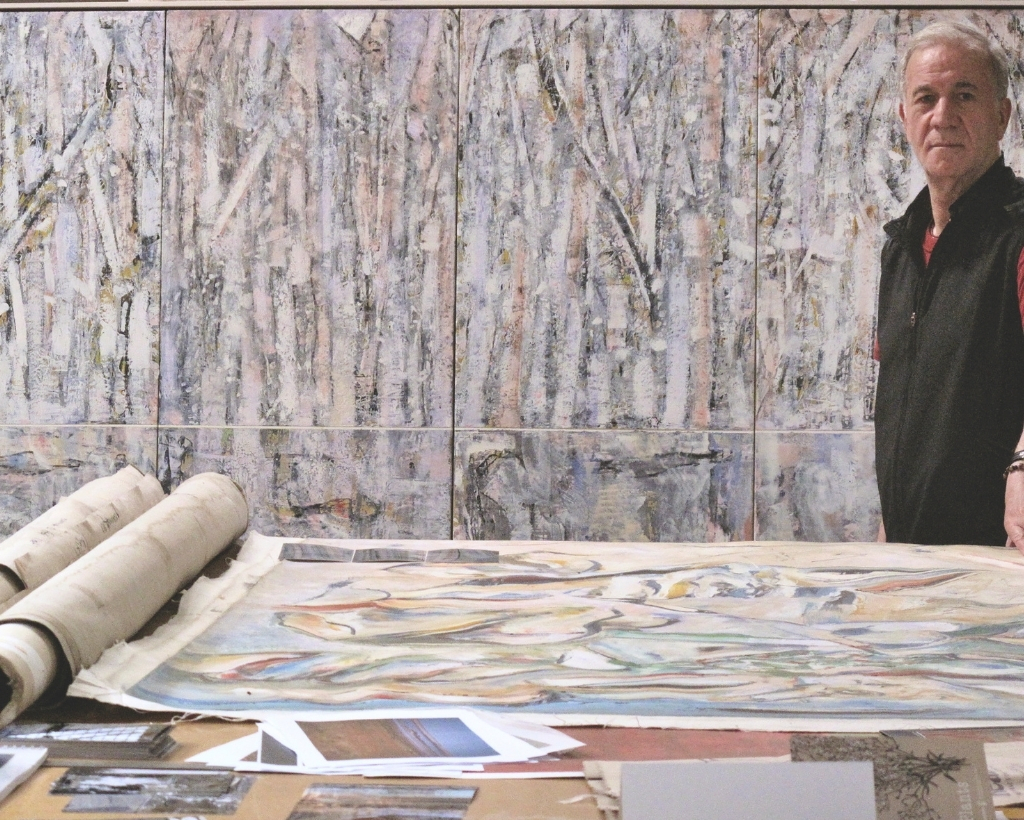
Currently, Leti is engaged in retrospective work connected to an upcoming documentary examining his life and practice. At the same time, new book projects continue to unfold—evidence of a mind still generative, still searching. His studio remains a site of layered media: painting, printmaking, collage, artist books. Objects carry biography. Pages invite interpretation.
At the core of his philosophy lies a simple yet expansive conviction: creative expression transcends nationality, age and category. It is not the privilege of artists alone, but a universal human quality. “Art,” Leti says, “is how we remain present.”
In Bruno Leti’s world, migration becomes memory, memory becomes image, and image becomes dialogue—across continents, generations and time itself.

