


Aaron Carpene's musical crossroads
Frolic reimagines Italian Opera through Asian storytelling
For nearly two decades, Italian-Australian conductor Aaron Carpenè, through his company FROLIC, has created musical-theatre that combine Western opera with traditional Asian storytelling. After projects in Bhutan, Japan, and Korea, he now sets his sights on Australia for his next cross-cultural venture.
What does Monteverdi’s L’Orfeo have in common with the Japanese tale of Izanami and Izanagi? Or Mozart’s The Magic Flute with the Cambodian versions of The Ramayana? For many of us, the connections may not be immediately obvious, but for Aaron Carpenè and FROLIC co-creator Stefano Vizioli, uncovering parallels is at the heart of their creative practice.
Since 2004 the duo have worked across Asia creating explorative musical-theatre productions that combine Western opera with Japanese, Bhutanese, and Cambodian storytelling. Their aim is to highlight cultural synergies and underline universal truths. Despite geographical, linguistic, and cultural barriers, our myths and tales of morality are remarkably similar—suggesting that, at our core, so are we.
“FROLIC brings together opera and these universal connections,” says Carpenè. “We focus predominately on early European opera which talks a lot about myths, and these stories have universal connections. It would be strange to stage something like La Bohème or La Traviata in the Himalayas.”
FROLIC began when Carpenè was working on a project in Bhutan as a guest of the foreign minister. He had the opportunity to present a production of Handel’s Acis and Galatea to the Prime Minister.
“I recall thinking: ‘How can I make this project relevant and interesting to a society unfamiliar with Western opera?’ Rather than having the Bhutanese as a passive audience, we came up with the idea of integrating their music, dance, and costumes into the Handel opera. We created an intercultural platform; we found the narrative commonalities and created a theatre piece around it.”
The result, Handel in the Kingdom of the Dragon, intertwined the myth of Acis and Galatea with the performing traditions of Bhutan. Premiering in Thimphu in 2013 in the presence of H.M. the Queen Mother Ashi Sangay Choden Wangchuck, the production reinforced shared Eastern and Western values surrounding compassion, death, reincarnation, and transfiguration.
After the world premiere, FROLIC staged the production in the USA before turning their attention to other operas in different countries. “In Bhutan, we saw elements that could have literally been taken out of 14th century Venice’s commedia dell’arte,” Carpenè reflects. “We really understood that there are deep connections between West and East in mysterious ways—and that was one of the rewarding things for me. My vision for these projects is built on four points: connecting past, present and future, and connecting two seemingly opposite cultures. We’re really focused on finding an equilibrium with all of these.”
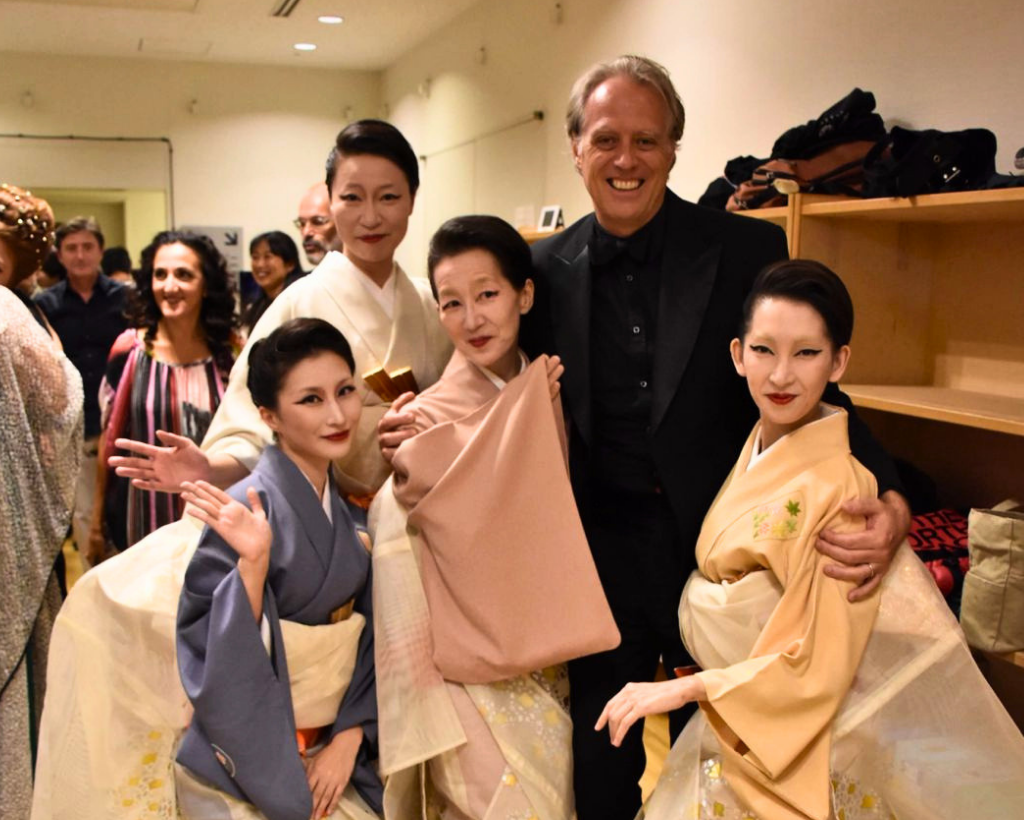
This approach led them to Japan, where they fused Orfeo with local mythology. “In Japanese culture, Izanami dies and Izanagi journeys to the underworld—just like Orpheus and Eurydice. Discovering these parallels enriched the storytelling. We did a similar project in Cambodia with The Magic Flute.”
Carpenè, who was born and raised in Western Australia, is now looking closer to home for his next two projects. While he remains tight-lipped on one that is “in very early development”, he reveals he is collaborating with First Nations’ storytellers on a new production of Acis and Galatea set in the Kimberley. “This work looks at the theme of water and everything that it means in the Kimberley. This region has one of the world’s last pristine river systems and incredible monsoon seasons—there is an important message of how we need to work together to protect water. When Acis transforms into a river and Galatea says, ‘from the rock gushes forth this river, this water which flows evermore,’ that image is profoundly Kimberley.”
Such cross-cultural projects come with challenges—geographical distance, language barriers, and cultural sensitives among them. Yet for Carpenè, the pay-off is worth it. “People who have worked on these shows have said the experiences were life-changing.”
“The projects push beyond people’s usual conception of opera. For many, opera is a soprano in a frock singing. But FROLIC’s productions were completely new to audiences, and that newness challenged their perception of the art form—and some people don’t like being challenged. But I love exploring the creases in the folds. That’s where things become interesting, powerful, complex and different.”

